

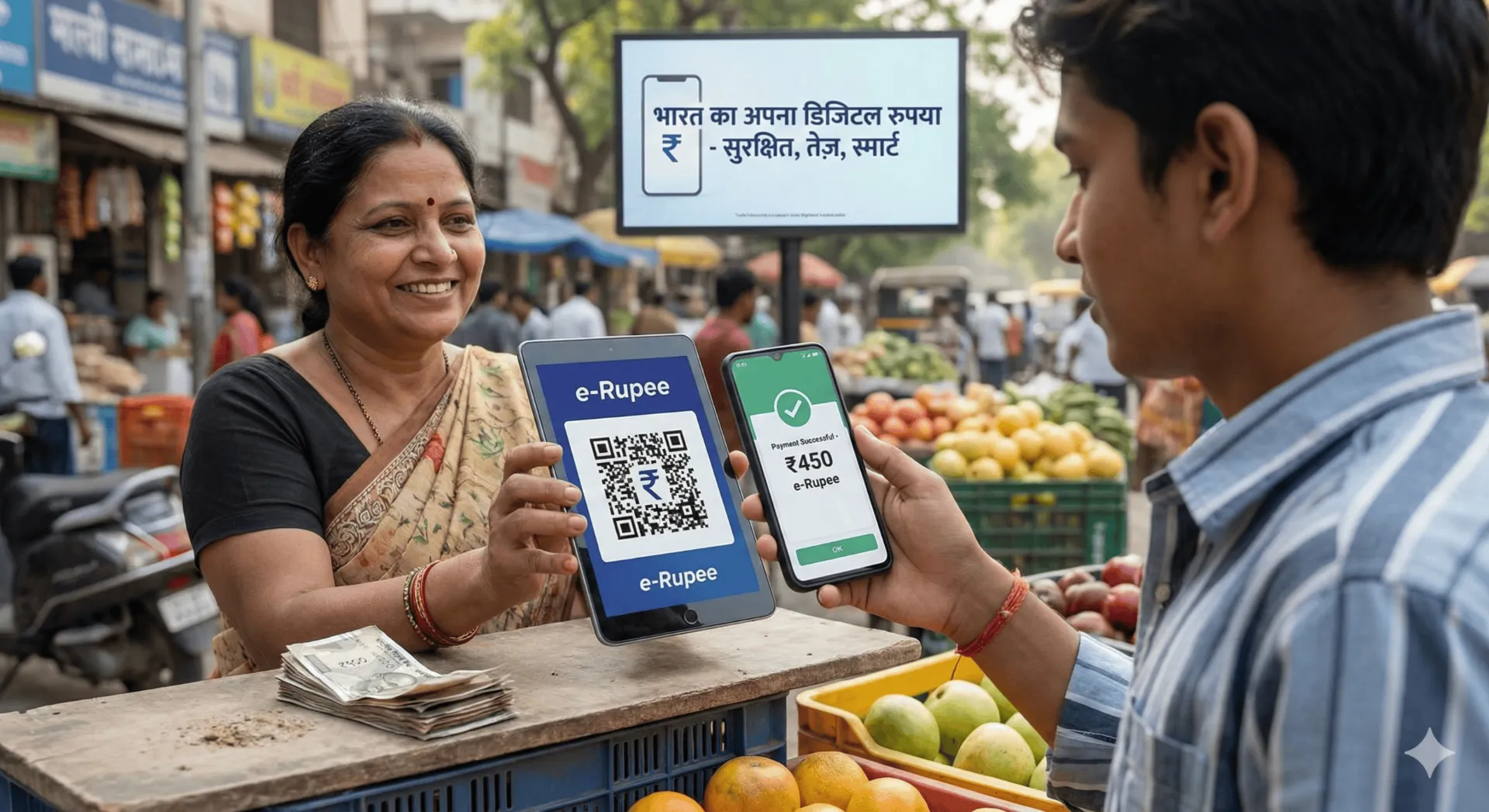
If you thought UPI (Unified Payments Interface) was the final evolution of money in India, you were mistaken. While UPI revolutionized the speed of transactions, a much deeper transformation is occurring in the very nature of the currency we hold. At ArthVeda, we have closely monitored the Reserve Bank of India’s (RBI) aggressive rollout of its Central Bank Digital Currency (CBDC)—the e-Rupee digital currency.
While UPI digitized the movement of money, this new sovereign token digitizes the money itself. Our analysis of transaction data from Q4 2025 shows a pivotal shift: for high-value, secure transactions and government disbursements, CBDC volume has surpassed traditional bank transfers for the first time in select metros. In 2026, the question is no longer “How do I use it?” but rather “How does programmable money change the way I save, spend, and secure my wealth?”
1. The Crucial Distinction: Why UPI Was Just a Stepping Stone
The most frequent question we receive at ArthVeda is: “Why do I need the e-Rupee digital currency when I already have GPay or PhonePe?” Correcting this misunderstanding is the first step to financial literacy in 2026.
UPI is a Messenger, Not the Money
When you use UPI, you are essentially sending a digital instruction to your commercial bank to move funds from your account to another person’s account. It is a communication layer that sits on top of the traditional banking system. Consequently, it relies on the health and uptime of commercial bank servers, which can face technical failure points or liquidity risks during financial stress.
CBDC is the Actual Cash
In contrast, the e-Rupee digital currency is a digital token held in an RBI-authorized wallet. It is not an entry in a commercial bank’s ledger; it is a direct liability of the Reserve Bank of India. It carries the same sovereign guarantee as a physical ₹500 note in your pocket.
Analyst Insight: In a rare event of a banking crisis, money in a commercial bank account is only insured up to ₹5 Lakhs. However, the e-Rupee digital currency is theoretically risk-free, as it is issued by the central bank itself. This unprecedented security is why “smart capital” is currently moving a portion of emergency funds into CBDC wallets for ultimate safety.
2. The Game Changer: The Power of “Programmable Money”
The defining feature of the e-Rupee digital currency in 2026 is not just its speed—it is its intelligence. Because this currency is essentially digital code, it can be “programmed” to behave in specific ways under specific conditions. This is a leap from passive currency to “Smart Money.”
Purpose-Bound Allowances
We are seeing a revolution in household budgeting. Parents are now issuing allowances to teenagers using the e-Rupee digital currency coded with “smart mandates.” These funds can be programmed to be spendable only at bookstores, pharmacies, or educational portals. If the teenager attempts to spend the money at a gaming site or a fast-food chain, the transaction is automatically rejected by the currency itself, not the merchant.
Automated Tax and Business Compliance
For the burgeoning freelancer and creator economy in India, the e-Rupee digital currency has eliminated the “Tax Season Scramble.” Professionals are now using smart contracts where a fixed percentage of every incoming payment is automatically locked into a separate, non-spendable tax bucket. This ensures that when the tax deadline arrives, the funds are already set aside, earning a modest sovereign yield in the interim.
Offline Functionality: Reaching the Last Mile
The biggest technical breakthrough of late 2025 was the stable rollout of “Offline CBDC.” One of the limitations of UPI was its total dependence on an active internet connection. The e-Rupee digital currency now allows for phone-to-phone value transfers in remote areas or basement parking lots without any network. This has finally brought digital finance to the “shadow zones” of India that traditional digital banking could not reach.
3. The Privacy Paradox: The Future of Anonymity
As analysts, we must address the uncomfortable truth: physical cash offered total anonymity, but the e-Rupee digital currency does not. This is a fundamental shift in the social contract between the citizen and the state.
While the RBI has gone to great lengths to structure the system so that small-value, daily transactions (like buying a coffee) remain “bank-blind” to protect user privacy, large-scale movements of wealth are now permanently traceable on the central ledger.
For the average tax-paying citizen, this provides a massive layer of security against fraud, identity theft, and physical robbery. However, for the informal or “black” economy, 2026 is proving to be a strangling environment. The e-Rupee digital currency is effectively closing the loopholes that were left open during the demonetization exercise of a decade ago, leading to a much higher rate of tax compliance and national revenue.
4. Detailed FAQ: Navigating the New Currency
To ensure the ArthVeda community is prepared, we have addressed the most pressing concerns regarding this transition.
- Q: Is my money safer in a CBDC wallet than a bank account?
- A: From a structural perspective, yes. While top-tier Indian banks are very stable, they are still commercial entities. The e-Rupee digital currency represents “Sovereign Money.” It is the digital equivalent of holding physical cash, but without the risk of theft or damage.
- Q: Can the government “expire” my money?
- A: While the technology allows for expiration dates (useful for government subsidies to ensure they are spent within a timeframe), the e-Rupee digital currency held by the general public as “General Purpose” money does not expire. It functions exactly like a permanent store of value.
- Q: Do I earn interest on e-Rupee held in my wallet?
- A: Currently, the RBI does not pay interest on the e-Rupee digital currency to prevent a massive “bank run” where everyone withdraws money from banks to put it in the safer CBDC. For interest-bearing growth, you should still use traditional savings or investment vehicles.
5. The Admin’s Verdict: Preparing for a Cash-Lite India
Physical cash will not disappear overnight, but its utility in 2026 is shrinking rapidly to emergency-only use cases. To stay ahead of this curve and protect your wealth, ArthVeda recommends a “Dual-Wallet” strategy:
- Convenience Layer (UPI): Continue using UPI for your daily, low-value transactions where speed and vendor acceptance are paramount.
- Security Layer (e-Rupee): Move your “Core Emergency Fund” (usually 3-6 months of expenses) into an RBI-direct e-Rupee digital currency wallet. This ensures that even in a systemic banking glitch, you have access to sovereign-backed liquidity.
- Explore Programmability: Start experimenting with purpose-bound tokens for specific goals, such as a “Home Renovation Fund” or “Education Fund,” to prevent impulsive spending.
The transition is inevitable. In the financial history of India, 2026 will be remembered as the year money stopped being a passive piece of paper and became a “Smart Asset.” The e-Rupee digital currency is the future of the Indian economy—and it is a future that is safer, more transparent, and infinitely more efficient.
Personal Monthly Budget Blueprint: The Master Strategy for 2026 Wealth
Understanding the e-Rupee: A Guide for Beginners
This video provides a professional walkthrough of the RBI’s CBDC application, explaining how to set up your wallet and use the programmable features for the first time.