

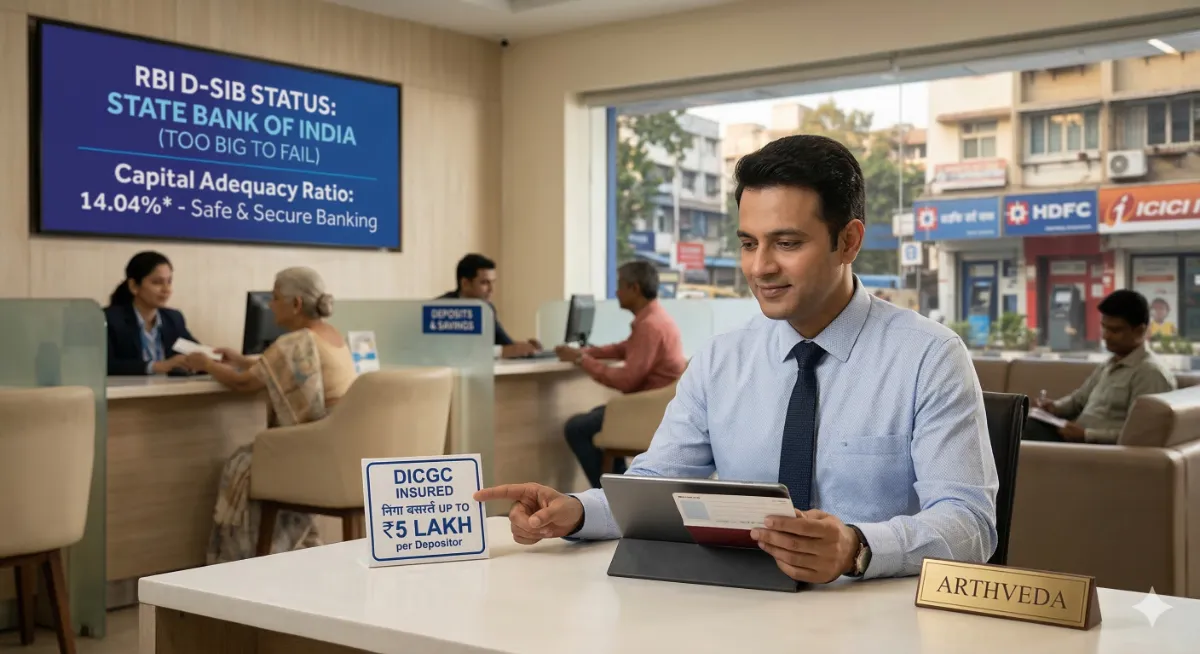
In an era of global financial volatility, the question echoing through every household in India is simple yet profound: “How safe is my hard-earned money in my bank account?” As we navigate the complexities of the 2026 financial landscape, understanding the pillars of banking system safety in India has become a necessity rather than a choice for the prudent investor.
The Fortress: Understanding the Regulatory Framework
The bedrock of financial stability in the subcontinent is the Reserve Bank of India (RBI). Unlike many Western counterparts that lean heavily on de-regulation, the banking system safety in India is built on a “conservative-first” approach. The RBI acts not just as a monitor, but as a proactive guardian.
Through stringent Capital Adequacy Ratios (CAR) and Cash Reserve Ratio (CRR) mandates, the RBI ensures that banks maintain a significant buffer against potential losses. This layered defense is the primary reason why banking system safety in India remained resilient even during the global contagion risks of the early 2020s.
The Safety Net: What is DICGC Insurance?
When discussing banking system safety in India, one cannot overlook the Deposit Insurance and Credit Guarantee Corporation (DICGC). This is the ultimate “fail-safe” for the common man.
Currently, every depositor in a bank is insured up to a maximum of ₹5 lakhs for both principal and interest amount. This insurance covers:
- Savings Accounts
- Fixed Deposits (FDs)
- Current Accounts
- Recurring Deposits (RDs)
If you have deposits in different branches of the same bank, they are aggregated for this limit. However, if you hold deposits in different banks, the ₹5 lakh limit applies separately to each bank, further enhancing the banking system safety in India for those who diversify their holdings.
The “Too Big To Fail” Concept: D-SIBs
A critical component of banking system safety in India is the classification of Domestic Systemically Important Banks (D-SIBs). These are institutions—currently including SBI, ICICI Bank, and HDFC Bank—whose failure would cause significant disruption to the national economy.
Because these banks are integral to the banking system safety in India, the RBI subjects them to even more rigorous oversight and higher capital requirements. In the eyes of the regulator, these banks are “too big to fail,” providing an unofficial but potent layer of security for millions of depositors.
Prompt Corrective Action (PCA) Framework
The RBI doesn’t wait for a bank to collapse before intervening. The PCA framework is a diagnostic tool that triggers automatically when a bank’s financial health hits certain “tripwires.” By restricting dividend payments, branch expansions, or even management compensation, the PCA ensures that the banking system safety in India is never compromised by the mismanagement of a single entity.
How to Audit Your Own Bank’s Safety
As an author at Arthveda, I believe in empowering the reader. To verify the banking system safety in India regarding your specific bank, you should look at these three metrics:
- Gross NPA (Non-Performing Assets): High NPAs indicate poor lending habits.
- CASA Ratio: A high Current Account Savings Account ratio means the bank has access to low-cost funds.
- Capital Adequacy Ratio (CAR): This shows how well the bank can handle a sudden “run” or loss.
The Digital Threat: Cybersecurity in 2026
In 2026, banking system safety in India isn’t just about balance sheets; it’s about firewalls. With the rise of sophisticated AI-driven phishing and deepfake scams, the RBI has mandated multi-factor authentication (MFA) and real-time fraud monitoring systems. The banking system safety in India is now a digital fortress, yet the responsibility also lies with the user to maintain digital hygiene.
Public Sector vs. Private Sector Banks
A common debate regarding banking system safety in India is whether Government-owned (PSU) banks are safer than Private banks. While PSU banks have the implicit sovereign guarantee of the Indian government, top-tier private banks often boast better technology and lower NPAs. Both are vital parts of the robust banking system safety in India.
The Role of Technology in Modern Safety
Blockchain and Central Bank Digital Currency (CBDC)—the E-Rupee—are the latest additions to the banking system safety in India. By reducing the reliance on physical cash and settlement risks, these technologies are making the banking system safety in India more transparent and less prone to traditional errors.
Conclusion: Trust, but Verify
The banking system safety in India is arguably among the strongest in the world. Between the RBI’s eagle-eyed supervision, the DICGC insurance safety net, and the stringent PCA norms, your money is in good hands. However, true financial wisdom lies in diversification. Do not put all your eggs in one basket; utilize the multi-layered banking system safety in India by spreading your wealth across different reputable institutions.
At Arthveda, our mission is to ensure you don’t just earn money, but you protect it. Understanding the banking system safety in India is your first step toward true financial freedom.
Section 1: The Comparison Table (Financial Health 2026)
Place this table after the section where you discuss “How to Audit Your Own Bank’s Safety.”
| Bank Name | Type | D-SIB Status (Too Big To Fail) | Net NPA (%) | Capital Adequacy (CAR) |
| State Bank of India (SBI) | Public | ✅ Yes (Bucket 4) | 0.57% | 14.28% |
| HDFC Bank | Private | ✅ Yes (Bucket 2) | 0.33% | 18.80% |
| ICICI Bank | Private | ✅ Yes (Bucket 1) | 0.40% | 16.33% |
| Axis Bank | Private | ❌ No | 0.68% | 16.31% |
| Bank of Baroda | Public | ❌ No | 0.58% | 16.00%* |
Author’s Note: Lower Net NPA means the bank has fewer bad loans. Higher CAR means the bank has a bigger “cushion” to handle financial shocks.
Section 2: Infographic Layout (Visual Guide)
If you are using a tool like Canva to create an image, use this structure:
Title: The 3 Pillars of Banking Safety in India
Visuals: Use three vertical pillars or icons.
- Pillar 1: RBI Supervision (The Shield)
- Caption: Continuous monitoring through the PCA framework. If a bank’s health dips, RBI takes control before it’s too late.
- Pillar 2: DICGC Insurance (The Safety Net)
- Caption: Your deposits (Savings, FD, RD) are insured up to ₹5 Lakhs per bank. Even in a worst-case scenario, your core savings are protected.
- Pillar 3: D-SIB Classification (The Fortress)
- Caption: Banks like SBI, HDFC, and ICICI are mandated to hold extra capital because they are critical to the Indian economy.
Section 3: Content Optimization (For the “Expert Blogger” Feel)
To make the blog more professional, add this “Pro-Tip” box at the end:
💡 Arthveda Pro-Tip: The ‘Multi-Bank’ Strategy
If you have more than ₹5 Lakhs in savings, don’t keep it all in one bank. Divide your funds between one Large Public Sector Bank (like SBI) and one Top-Tier Private Bank (like HDFC or ICICI). This way, you maximize your DICGC insurance coverage and benefit from both government trust and private efficiency.
Legal Disclaimer: The information presented in this article regarding the Banking System Safety in India is for educational and informational purposes only. While we strive to maintain the highest standards of accuracy, financial data such as NPA ratios, capital adequacy, and regulatory norms are subject to change by the Reserve Bank of India (RBI) or respective financial institutions.
This content does not constitute professional financial, legal, or investment advice. Arthveda and its author, Ravi Shankar Sidar, shall not be held liable for any financial losses, damages, or legal issues arising from the use of this information. Readers are encouraged to consult a certified financial advisor and verify all facts from official government sources before making any banking or investment decisions. Mention of specific banks is for illustrative purposes only and does not imply an endorsement or a negative rating.
Income Tax Calculator (FY 2025-26 | AY 2026-27)
1 thought on “Is Your Money Truly Safe? An In-Depth Guide to Banking System Safety in India”