

Introduction: The Intersection of Geopolitics and Finance
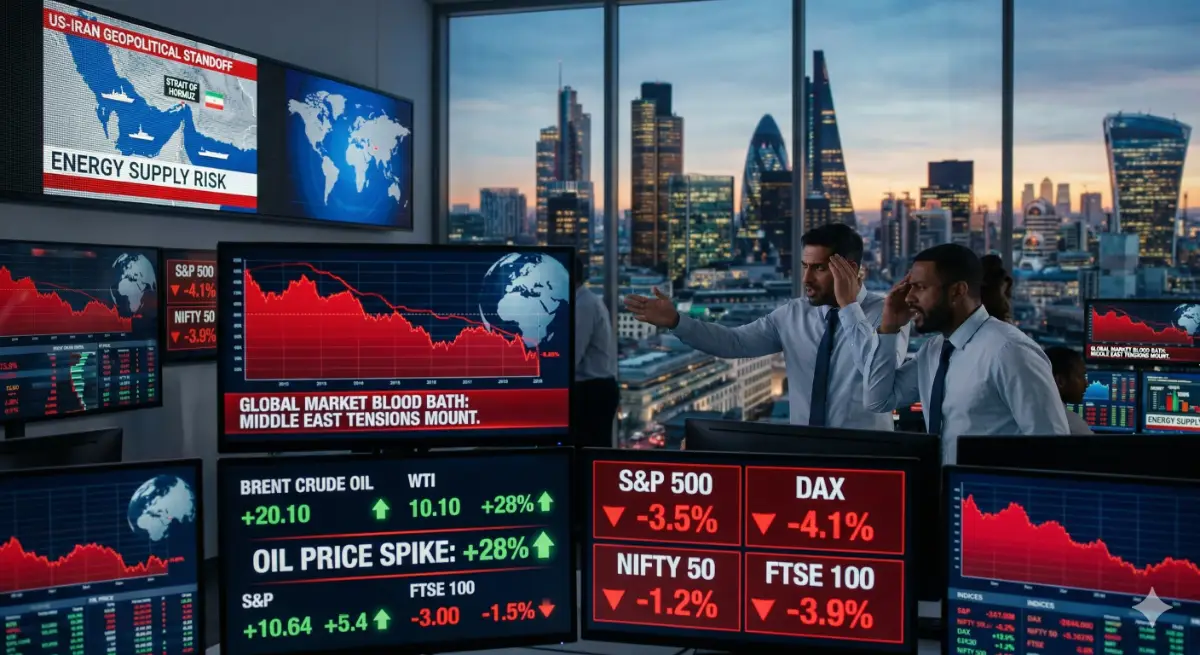
The world of finance is rarely static, but there are moments when external shocks send shockwaves through the entire system. We are currently witnessing one of those defining moments. The escalating US-Iran conflict has fundamentally altered the macroeconomic landscape, triggering what financial analysts are now calling a comprehensive global market bleed. This is not merely a localized correction; it is a synchronized downturn across equities, currencies, and bonds, driven by intense geopolitical uncertainty.
When two major geopolitical players engage in direct or proxy conflicts, the ramifications extend far beyond their borders. The Middle East remains the critical artery of global energy supplies. Consequently, any instability in this region translates instantly into economic anxiety. For investors, understanding the mechanics of this global market bleed is essential. It is not enough to simply watch red tickers on a screen; one must comprehend the underlying forces driving capital flight, the restructuring of global supply chains, and the shifting paradigms of risk management.
This comprehensive analysis will dissect the current financial climate, examining how the US-Iran conflict became the catalyst for the global market bleed, how different asset classes are reacting, and what strategic moves investors can make to insulate their portfolios against ongoing volatility.
The Catalyst: Anatomy of the US-Iran Conflict
To understand the financial fallout, one must first understand the geopolitical catalyst. The relationship between the United States and Iran has been characterized by decades of tension, punctuated by sanctions, diplomatic standoffs, and regional proxy engagements. However, the recent escalation represents a significant departure from the status quo.
The immediate trigger—whether a breakdown in diplomatic negotiations, military posturing in the Strait of Hormuz, or targeted strikes—has introduced a level of unpredictability that markets abhor. Financial markets operate efficiently on the pricing of known risks; unknown or unquantifiable risks lead to panic selling.
The primary concern is the Strait of Hormuz, a narrow waterway between the Persian Gulf and the Gulf of Oman. A significant percentage of the world’s total global petroleum liquids consumption passes through this strait. Any threat of closure or disruption immediately injects a massive risk premium into energy markets. This single geographic chokepoint is the linchpin connecting the US-Iran conflict to the global market bleed. When oil supplies are threatened, the cost of manufacturing, transportation, and basic goods rises globally, threatening to stall economic growth and trigger stagflation.
The Mechanism of a Global Market Bleed
A global market bleed does not happen arbitrarily. It follows a specific psychological and algorithmic pattern. When news of the conflict broke, institutional investors, hedge funds, and algorithmic trading systems instantly recalibrated their risk models.
1. The Flight to Safety
The immediate reaction to geopolitical trauma is a massive capital reallocation. Investors dump riskier assets—such as emerging market equities, high-yield corporate bonds, and growth stocks—in favor of safe-haven assets. This mass exodus drains liquidity from global exchanges, precipitating the global market bleed. Capital flows aggressively into US Treasuries, Swiss Francs, Japanese Yen, and physical gold. The yield on government bonds drops as their prices surge, reflecting the premium investors are willing to pay for guaranteed preservation of capital, even at the cost of yield.
2. Equity Market Liquidation
As capital flees to safety, equity markets bear the brunt of the impact. The global market bleed is most visible on the trading floors of Wall Street, London, Tokyo, and Mumbai. Sectors highly dependent on stable energy prices, such as airlines, logistics, and consumer discretionary goods, experience rapid sell-offs. Furthermore, companies with significant exposure to Middle Eastern markets or those reliant on complex international supply chains face immediate downward revisions in their earnings forecasts. The VIX (Volatility Index), often referred to as Wall Street’s “fear gauge,” spikes dramatically, indicating that options traders expect significant near-term turbulence.
3. Currency Devaluations
Currency markets are highly sensitive to geopolitical shocks. In the wake of the conflict, currencies of nations heavily reliant on imported oil (such as India, Japan, and parts of Europe) face severe downward pressure. The cost of importing oil surges, widening trade deficits and leading to rapid currency depreciation. Conversely, the US Dollar often strengthens due to its status as the world’s primary reserve currency, creating a tightening effect on global financial conditions, particularly for emerging market sovereigns and corporations holding dollar-denominated debt.
The Energy Crisis: Oil as a Weapon
At the heart of this global market bleed is the energy sector. Oil is the lifeblood of the global economy, and the US-Iran conflict directly threatens its circulation.
Brent Crude and West Texas Intermediate (WTI) have both experienced parabolic price spikes. A sustained oil price shock acts as a regressive tax on consumers globally. It diminishes disposable income, suppresses retail spending, and forces corporations to absorb higher operational costs, compressing profit margins.
Historically, oil shocks driven by Middle Eastern conflicts—such as the 1973 oil embargo or the 1990 Gulf War—have resulted in extended periods of economic malaise. The current situation threatens a similar outcome. Central banks, which have spent years combating inflation, now face a nightmare scenario: a supply-side inflation shock. Unlike demand-driven inflation, which can be cooled by raising interest rates, supply-side inflation caused by geopolitical conflict cannot be fixed by central bank policy. If a central bank raises rates to fight oil-driven inflation, they risk plunging an already fragile economy into a deep recession.
Regional Impacts: A Synchronized Downturn
The global market bleed is not uniform; it impacts different regions in unique ways based on their economic structures and geopolitical alignments.
North American Markets
In the United States, the impact is twofold. While the US is a major oil producer and enjoys a degree of energy independence not seen in previous decades, its equity markets are deeply interconnected with the global economy. Multinational corporations making up the S&P 500 face headwinds from a strong dollar (making their exports less competitive) and slowing global demand.
European Markets
Europe is particularly vulnerable. Having recently navigated an energy crisis precipitated by the Russia-Ukraine conflict, European economies are highly sensitive to further supply chain disruptions. The Euro and the British Pound face pressure, and European manufacturing hubs, such as Germany, struggle with the dual burden of high energy input costs and declining export orders, accelerating the regional impact of the global market bleed.
Emerging Markets (Asia and Beyond)
Emerging markets often suffer the most acute symptoms of a global market bleed. Countries like India, which imports the vast majority of its crude oil requirements, face a triple threat: a plunging local currency, surging domestic inflation, and foreign capital outflows. The RBI (Reserve Bank of India) and similar central banks in emerging economies are forced to intervene in currency markets to prevent freefalls, depleting foreign exchange reserves in the process.
Historical Precedents: Lessons from the Past
To navigate the current global market bleed, it is instructive to look at historical precedents. Geopolitical shocks, while terrifying in the moment, have historically followed a predictable lifecycle in financial markets.
- The Initial Shock: The immediate aftermath of an event like the US-Iran escalation is characterized by panic. This is the acute phase of the global market bleed, where correlations approach 1 (meaning almost all asset classes drop simultaneously, except for safe havens).
- The Assessment Phase: Markets begin to stabilize as the initial panic subsides and institutional investors attempt to quantify the actual economic damage. Volatility remains high, but the sheer velocity of the sell-off slows down.
- The Recovery Phase: Eventually, markets price in the new geopolitical reality. If the conflict remains localized or does not completely shut down energy infrastructure, markets historically begin to recover within months of the initial shock.
The key takeaway for investors is that while a global market bleed destroys wealth in the short term, panic selling at the bottom often results in permanent capital loss.
Strategic Responses: Managing Portfolios Amidst Chaos
Surviving a global market bleed requires discipline, a clear head, and a strategic approach to asset allocation. Reacting emotionally to breaking news headlines is a recipe for financial disaster. Here are professional strategies to navigate the current turbulence:
1. Reassess, Do Not Panic Sell
The most common mistake retail investors make during a global market bleed is selling quality assets at depressed prices. Unless your fundamental investment thesis for a specific company has been permanently destroyed by the conflict, liquidating your portfolio simply locks in losses. Instead, reassess your risk tolerance. If the current volatility is keeping you awake at night, it indicates that your portfolio was likely too aggressive to begin with.
2. Tactical Diversification
True diversification is your primary defense against geopolitical risk. Ensure your portfolio is not overly concentrated in one geographic region or a single sector. During an event triggered by the US-Iran conflict, energy stocks and defense contractors may see short-term gains, while consumer discretionary and transportation sectors suffer. Balancing these exposures can mitigate the overall impact of the global market bleed on your net worth.
3. The Role of Safe Havens
If you do not currently have safe-haven assets in your portfolio, consider building positions incrementally. Physical gold and gold-backed ETFs remain the traditional hedge against geopolitical instability and currency debasement. Additionally, short-term government bonds can provide a secure parking place for cash while you wait for the volatility to subside.
4. Identifying Opportunities in the Wreckage
A severe global market bleed often creates generational buying opportunities. High-quality companies with robust balance sheets, strong cash flows, and unassailable market positions are frequently sold off indiscriminately alongside fundamentally weak companies. Warren Buffett’s adage to be “greedy when others are fearful” applies here. Keep a watch list of blue-chip stocks that you have always wanted to own, and be prepared to deploy cash when their valuations become historically attractive due to market panic.
5. Monitor Central Bank Communications
The ultimate arbiter of when the global market bleed will end is often central bank policy. Pay close attention to the communications from the Federal Reserve, the European Central Bank, and other major monetary authorities. If central banks signal that they are willing to provide liquidity or pause interest rate hikes to stabilize the financial system, it frequently marks the bottom of the market correction.
Conclusion: Resilience in the Face of Uncertainty
The ongoing US-Iran conflict has undeniably introduced a severe stress test to the global financial system. The resulting global market bleed serves as a stark reminder of the fragile interconnectivity of modern economies. While the immediate outlook is clouded by geopolitical tension, oil price shocks, and volatile equity markets, it is crucial to maintain a long-term perspective.
Financial markets have survived wars, pandemics, and institutional collapses. They are highly adaptive systems designed to process new information and re-price risk continuously. As an investor, your goal is not to predict the unpredictable twists of geopolitical conflict, but to build a portfolio resilient enough to withstand the shocks. By understanding the mechanisms driving the current global market bleed, maintaining diversification, and resisting the urge to capitulate to fear, investors can navigate this turbulent period and position themselves for the eventual recovery. The news may be grim today, but disciplined, methodical investing remains the most proven strategy for long-term wealth preservation.
The Fed’s Best Response to the Iran Conflict Is to Follow Monetary Rules