

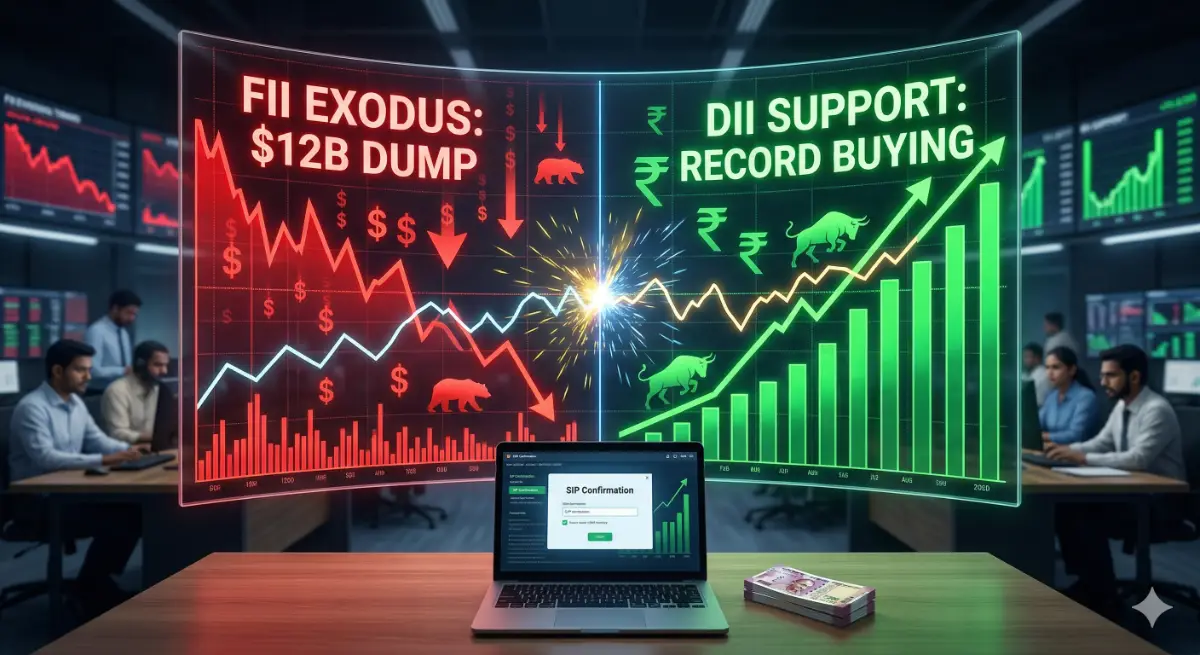
The Indian financial landscape is currently the battleground for a historic tug-of-war. On one side, we are witnessing an unprecedented flight of foreign capital; on the other, a formidable wall of domestic liquidity standing firm against the tide. As of late March 2026, the Indian equity markets have been jolted by a staggering $12 billion selloff by Foreign Institutional Investors (FIIs). Yet, despite this massive withdrawal, the catastrophic market collapse that traditionally follows such an event has not materialized.
The savior? The relentless, disciplined capital deployment by Domestic Institutional Investors (DIIs).
For the modern investor, understanding the mechanics of this clash is no longer just an academic exercise—it is essential for survival and wealth creation in a highly volatile macroeconomic environment. This comprehensive guide will decode the triggers behind the FII exodus, analyze the structural strength of DII support, and provide a strategic playbook for retail investors navigating this turbulence.
Table of Contents
1. The Anatomy of the $12 Billion Dump
To understand why foreign money is leaving Dalal Street at a record pace, we must zoom out and look at the global macroeconomic chessboard. Capital is inherently cowardly; at the first sign of severe global distress, it flees emerging markets and seeks the safety of the US Dollar and sovereign bonds. The current FII exodus is not a localized rejection of India’s growth story, but a systemic reaction to a confluence of global crises.
The Geopolitical Trigger: The Oil Shock of 2026
The most immediate catalyst for the massive selloff is the escalating geopolitical tension in the Middle East, specifically the US-Iran conflict. With Brent crude violently breaching the $116 per barrel mark, global inflation projections have been rewritten overnight. India, which imports over 80% of its crude oil requirements, is exceptionally vulnerable to these price shocks. For foreign investors, a rising crude bill translates directly into a widening Current Account Deficit (CAD), imported inflation, and potential margin compression for Indian corporates. This macro vulnerability makes Indian equities a prime target for risk-off selling.
The “Flight to Safety” and Surging Yields
When global instability peaks, the “risk-free” rate in developed markets often adjusts. In an attempt to combat the sudden inflationary pressures of the oil shock, global bond yields have spiked. When an FII can earn a guaranteed, high yield on US Treasury bonds, the risk premium required to invest in emerging market equities like India increases significantly. Consequently, massive algorithmic and active funds have aggressively rebalanced their portfolios, pulling billions out of Indian stocks to park them in safe-haven Western assets.
Valuation Discomfort
Before the crash, Indian equities were trading at a premium compared to their emerging market peers. Dalal Street was priced for perfection. When the macroeconomic environment shifted from “perfect” to “highly uncertain,” foreign investors were quick to book profits. The $12 billion dump was, in many ways, an aggressive realization of gains built up during the bull run of the preceding years.
2. The DII Fortress: How Domestic Money is Holding the Line
Historically, an FII exodus of this magnitude would have sent the Sensex and Nifty into a freefall, eroding 20% to 30% of market capitalization in a matter of weeks. We saw this during the 2008 Global Financial Crisis and the early days of the 2020 pandemic. However, 2026 is fundamentally different.
The Financialization of Indian Savings
The true hero of the current market scenario is the everyday Indian investor. Over the last decade, there has been a massive structural shift in how Indians save. The transition from physical assets (like real estate and physical gold) to financial assets has created a formidable domestic capital pool. Mutual funds, insurance companies, and pension funds now wield unprecedented purchasing power.
The SIP Juggernaut
The backbone of DII support is the Systematic Investment Plan (SIP). Retail investors are consistently pumping tens of thousands of crores into equity mutual funds every single month, regardless of market volatility. This “sticky capital” provides fund managers with a continuous stream of dry powder. When FIIs dump large-cap, blue-chip stocks at discounted prices, DIIs are eagerly waiting on the other side of the trade to absorb the supply. This monthly SIP inflow acts as a massive shock absorber, ensuring that the market does not collapse under the weight of foreign selling.
Insurance and EPFO Buying
Beyond mutual funds, the Employees’ Provident Fund Organisation (EPFO) and major life insurance corporations are mandated to deploy a portion of their massive corpuses into equities. During sharp market corrections triggered by an FII exodus, these domestic giants often step in as buyers of last resort, accumulating high-quality assets at distressed valuations for their long-term portfolios.
3. Sectoral Impact: Where is the Money Flowing?
The $12 billion dump has not been uniform across the board. Certain sectors have borne the brunt of the foreign selling, while others have seen robust domestic accumulation.
The Casualties of the Exodus
- Banking and Financial Services (BFSI): Historically, FIIs have held the highest weightage in Indian financials. Private sector banks, despite robust balance sheets and strong credit growth, have seen intense selling pressure simply because they are the most liquid assets for foreign funds to dump when they need to raise cash quickly.
- Information Technology (IT): The Indian IT sector is highly dependent on US and European client spending. With the global economic outlook darkening due to the oil shock, fears of delayed IT spending and shrinking corporate budgets have led to FIIs unwinding their positions in top-tier tech firms.
The Beneficiaries of DII Support
- Public Sector Undertakings (PSUs) and Defense: Domestic funds have heavily favored government-backed entities, particularly those in defense, railways, and infrastructure. These sectors are largely insulated from global macroeconomic shocks and rely entirely on the domestic government’s capital expenditure (Capex) cycle.
- FMCG and Domestic Consumption: Fast-Moving Consumer Goods companies offer a defensive play. Regardless of global wars or oil prices, domestic consumption of basic goods remains relatively stable. DIIs have rotated capital into these safe-haven sectors to protect their portfolios from high-beta volatility.
4. The Macroeconomic Ripple Effects
The clash between FII selling and DII buying extends beyond just stock prices; it has profound implications for the broader Indian economy.
Currency Under Pressure
When FIIs sell Indian stocks, they receive Indian Rupees, which they then convert into US Dollars to repatriate their funds. This massive demand for Dollars and supply of Rupees puts immense depreciatory pressure on the Indian currency. However, the Reserve Bank of India (RBI) has proactively utilized its substantial forex reserves and implemented strategic market caps to defend the Rupee, preventing a complete currency rout.
Liquidity and Interest Rates
Persistent foreign outflows can tighten domestic liquidity. If the RBI intervenes heavily in the forex market by selling Dollars, it simultaneously sucks out Rupee liquidity from the domestic banking system. This can lead to short-term spikes in interbank lending rates, forcing the central bank to conduct strategic liquidity infusion operations to ensure the banking system operates smoothly.
5. The Long-Term Implications of FII Under-Ownership
While the immediate narrative focuses on the pain of the selloff, there is a compelling silver lining for the long-term domestic investor. The current FII exodus is resulting in a significant transfer of asset ownership from foreign hands to domestic hands.
As DIIs and retail investors accumulate quality businesses at discounted prices, the future dividends, capital appreciation, and wealth generation of these companies will remain within the Indian economy. Furthermore, as FII ownership percentages drop to multi-year lows, the market becomes progressively less vulnerable to future global shocks. When the geopolitical situation eventually stabilizes and foreign capital inevitably returns to emerging markets, they will find an Indian market largely owned by its citizens, forcing them to buy back in at much higher valuations.
6. Strategic Playbook for the Retail Investor
In the face of a $12 billion institutional dump, it is easy for a retail investor to succumb to panic. However, wealth is historically transferred from the impatient to the patient during periods of high volatility. Here is how you should position your portfolio:
1. Do Not Stop Your SIPs
The absolute worst financial decision you can make during an FII exodus is to pause or cancel your ongoing SIPs. Mutual fund SIPs are designed specifically to capitalize on market corrections. By continuing your investments, you are buying more units at lower Net Asset Values (NAVs). When the market inevitably recovers, this accumulated volume will serve as the primary engine for your portfolio’s compounding.
2. Shift Focus to Domestic Themes
Minimize your exposure to companies whose fortunes are tied entirely to global supply chains, European markets, or US corporate spending. Instead, align your portfolio with domestic growth drivers. Look at companies benefiting from rural consumption recovery, government infrastructure spending, and the domestic manufacturing push (PLI schemes).
3. Exploit the Large-Cap Valuation Gap
Because foreign funds primarily sell highly liquid, large-cap stocks to exit the market quickly, many fundamentally flawless blue-chip companies are currently trading at severe discounts to their intrinsic value. This presents a rare, low-risk entry point for retail investors. Use your excess cash reserves to selectively accumulate market leaders in the banking and consumer spaces that have been unfairly punished by the systemic selloff.
4. Rebalance, Don’t React
Volatility should prompt a review of your asset allocation, not an emotional exit from the market. If your portfolio was heavily skewed toward high-risk mid and small-cap stocks during the previous bull run, use this opportunity to rebalance. Move capital into defensive large-caps, or consider increasing your allocation to safe-haven assets like gold and silver, which are currently experiencing a structural re-pricing as growth assets.
7. Conclusion: The Maturation of Dalal Street
The $12 billion FII exodus of 2026 will be remembered not as a market crash, but as the ultimate stress test of India’s domestic financial infrastructure. The fact that the markets have absorbed a historic offloading of equities without a systemic breakdown is a testament to the maturation of Dalal Street.
The narrative has fundamentally shifted. The Indian equity market is no longer solely dependent on the whims of foreign capital. The rise of the domestic institutional investor and the financial discipline of the retail participant have created a resilient, self-sustaining ecosystem. For the pragmatic investor, this volatility is not a signal to retreat, but a generational opportunity to acquire a stake in India’s long-term economic future at a discounted price.
Stay invested, stay disciplined, and let the panic of others be the foundation of your future wealth.
Frequently Asked Questions (FAQs)
Q1: What exactly is an FII exodus?
An FII exodus refers to a scenario where Foreign Institutional Investors rapidly sell off large volumes of their holdings in a domestic market (like India) and move their capital to other countries or safer asset classes, usually in response to global economic or geopolitical risks.
Q2: Why are DIIs continuing to buy when foreign investors are selling?
Domestic Institutional Investors, particularly mutual funds, have a continuous inflow of cash from retail investors via SIPs. Additionally, DIIs often take a longer-term view of the domestic economy. When foreign funds sell, it drives down stock prices, allowing DIIs to buy fundamentally strong companies at attractive valuations.
Q3: Is my mutual fund portfolio safe during this selloff?
Yes. While the absolute value of your portfolio may show a temporary dip due to overall market sentiment, mutual funds are managed by professionals who actively use this volatility to rebalance and buy cheaper assets. Stopping your investments during this phase actively harms your long-term returns.
Q4: Will the foreign investors ever return to the Indian market?
Absolutely. Capital flows are cyclical. Once the current macroeconomic shocks (like the oil price spike and geopolitical tensions) stabilize, global risk appetite will return. Given India’s strong GDP growth trajectory and demographic advantages, foreign funds will inevitably return to buy into the Indian growth story, often at higher prices.
Mastering the Markets: A Comprehensive Guide to Stock Market Basics
What is FII and DII? Meaning, Full Forms, and Role in Indian Stock Market